

How Do We Characterize A Population's Genetic Makeup
Learning Objectives
By the cease of this department, you volition be able to:
- Describe the unlike types of variation in a population
- Explain why only heritable variation tin can be acted upon past natural selection
- Depict genetic drift and the bottleneck consequence
- Explain how each evolutionary force can influence the allele frequencies of a population
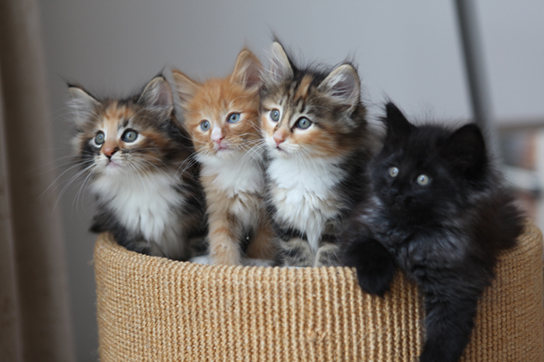 Effigy one. The distribution of phenotypes in this litter of kittens illustrates population variation. (credit: Pieter Lanser)
Individuals of a population oft display unlike phenotypes, or express different alleles of a particular gene, referred to every bit polymorphisms. Populations with two or more variations of particular characteristics are called polymorphic. The distribution of phenotypes among individuals, known as the population variation, is influenced by a number of factors, including the population's genetic construction and the environment (Figure 1). Understanding the sources of a phenotypic variation in a population is important for determining how a population volition evolve in response to different evolutionary pressures.
Genetic Variance
Natural pick and some of the other evolutionary forces tin can only deed on heritable traits, namely an organism'south genetic code. Considering alleles are passed from parent to offspring, those that confer beneficial traits or behaviors may be selected for, while deleterious alleles may be selected against. Acquired traits, for the most office, are not heritable. For example, if an athlete works out in the gym every day, building up musculus strength, the athlete'due south offspring will not necessarily grow up to exist a torso builder. If there is a genetic basis for the ability to run fast, on the other hand, this may exist passed to a child.
Link to Learning
Before Darwinian evolution became the prevailing theory of the field, French naturalist Jean-Baptiste Lamarck theorized that acquired traits could, in fact, be inherited; while this hypothesis has largely been unsupported, scientists have recently begun to realize that Lamarck was non completely incorrect. Visit this site to learn more.
Heritability is the fraction of phenotype variation that can be attributed to genetic differences, or genetic variance, among individuals in a population. The greater the hereditability of a population'southward phenotypic variation, the more than susceptible it is to the evolutionary forces that act on heritable variation.
The multifariousness of alleles and genotypes within a population is called genetic variance. When scientists are involved in the breeding of a species, such as with animals in zoos and nature preserves, they effort to increase a population's genetic variance to preserve as much of the phenotypic diverseness every bit they can. This also helps reduce the risks associated with inbreeding, the mating of closely related individuals, which tin can take the undesirable consequence of bringing together deleterious recessive mutations that can crusade abnormalities and susceptibility to disease. For instance, a disease that is caused by a rare, recessive allele might exist in a population, just it volition only manifest itself when an individual carries two copies of the allele. Because the allele is rare in a normal, salubrious population with unrestricted habitat, the chance that ii carriers will mate is low, and fifty-fifty then, merely 25 percent of their offspring will inherit the disease allele from both parents. While it is likely to happen at some bespeak, it will not happen often enough for natural selection to be able to swiftly eliminate the allele from the population, and every bit a effect, the allele will be maintained at low levels in the genetic pool. However, if a family of carriers begins to interbreed with each other, this volition dramatically increase the likelihood of two carriers mating and somewhen producing diseased offspring, a phenomenon known every bit inbreeding depression.
Changes in allele frequencies that are identified in a population tin can shed light on how information technology is evolving. In addition to natural pick, at that place are other evolutionary forces that could be in play: genetic migrate, factor flow, mutation, nonrandom mating, and environmental variances.
Genetic Drift
The theory of natural option stems from the observation that some individuals in a population are more likely to survive longer and accept more offspring than others; thus, they volition laissez passer on more than of their genes to the next generation. A big, powerful male gorilla, for example, is much more than probable than a smaller, weaker ane to become the population'southward silverback, the pack's leader who mates far more than than the other males of the grouping. The pack leader volition begetter more offspring, who share one-half of his genes, and are likely to also grow bigger and stronger similar their father. Over time, the genes for bigger size will increment in frequency in the population, and the population will, equally a result, abound larger on average. That is, this would occur if this particular selection pressure, or driving selective force, were the only i acting on the population. In other examples, better camouflage or a stronger resistance to drought might pose a selection pressure.
Some other manner a population'south allele and genotype frequencies can change is genetic drift (Figure 2), which is simply the effect of chance. By risk, some individuals will have more than offspring than others—not due to an advantage conferred past some genetically-encoded trait, but just because one male person happened to be in the right place at the right time (when the receptive female walked past) or because the other one happened to exist in the wrong place at the incorrect fourth dimension (when a fox was hunting).
Art Connection
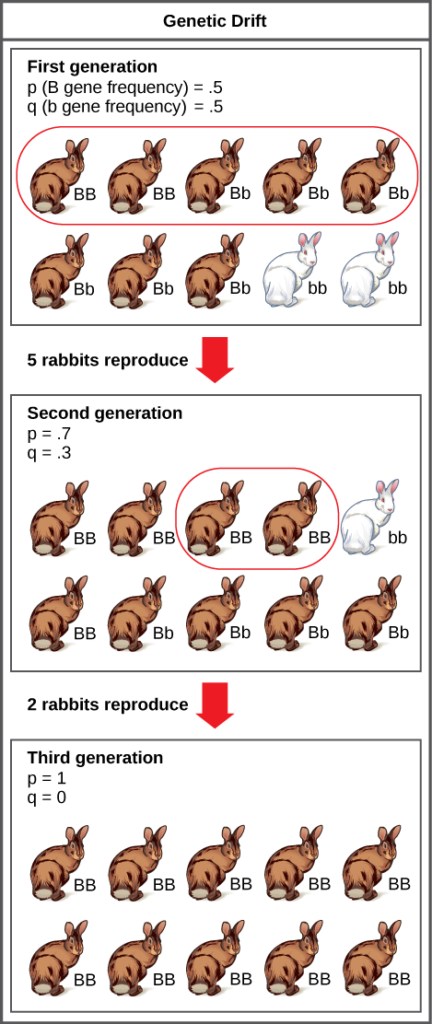 Figure 2. The genetic drift of a rabbit population.
Genetic drift in a population can lead to the elimination of an allele from a population by chance. In Figure 2, rabbits with the brown coat colour allele (B) are dominant over rabbits with the white coat colour allele (b). In the beginning generation, the 2 alleles occur with equal frequency in the population, resulting in p and q values of .5. Just half of the individuals reproduce, resulting in a second generation with p and q values of .vii and .three, respectively. Only ii individuals in the second generation reproduce, and by hazard these individuals are homozygous ascendant for chocolate-brown coat colour. As a event, in the third generation the recessive b allele is lost.
Exercise you recollect genetic migrate would happen more quickly on an island or on the mainland?
Small populations are more susceptible to the forces of genetic drift. Large populations, on the other manus, are buffered against the effects of chance. If 1 private of a population of 10 individuals happens to die at a young historic period before it leaves any offspring to the next generation, all of its genes—1/ten of the population's genetic pool—will exist suddenly lost. In a population of 100, that'due south but 1 percent of the overall gene pool; therefore, it is much less impactful on the population'south genetic structure.
Link to Learning
Become to this site to spotter an blitheness of random sampling and genetic drift in action.
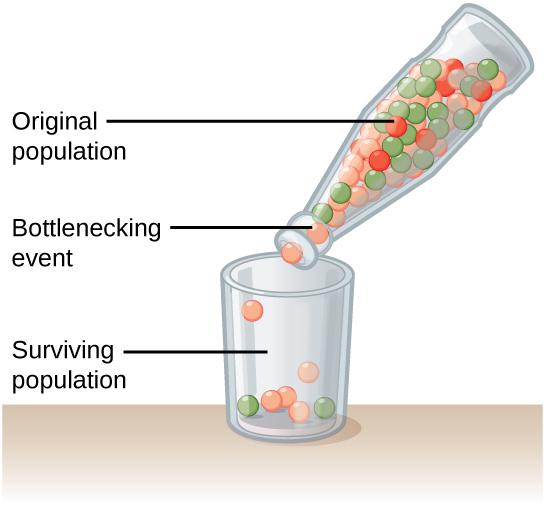 Effigy iii. A risk event or catastrophe can reduce the genetic variability within a population.
Genetic drift can too be magnified past natural events, such as a natural disaster that kills—at random—a big portion of the population. Known equally the bottleneck result, it results in a large portion of the genome suddenly existence wiped out (Figure 3). In 1 brutal swoop, the genetic structure of the survivors becomes the genetic structure of the entire population, which may be very different from the pre-disaster population.
Another scenario in which populations might experience a strong influence of genetic drift is if some portion of the population leaves to start a new population in a new location or if a population gets divided past a physical barrier of some kind. In this situation, those individuals are unlikely to be representative of the entire population, which results in the founder effect. The founder effect occurs when the genetic construction changes to lucifer that of the new population's founding fathers and mothers. The founder outcome is believed to accept been a key cistron in the genetic history of the Afrikaner population of Dutch settlers in Southward Africa, equally evidenced past mutations that are common in Afrikaners but rare in most other populations. This is likely due to the fact that a higher-than-normal proportion of the founding colonists carried these mutations. As a issue, the population expresses unusually loftier incidences of Huntington's affliction (Hard disk) and Fanconi anemia (FA), a genetic disorder known to cause blood marrow and congenital abnormalities—even cancer.[1]
Link to Learning
Picket this short video to learn more about the founder and clogging effects.
Scientific Method Connection
Testing the Bottleneck Issue
Question: How do natural disasters affect the genetic construction of a population?
Background: When much of a population is all of a sudden wiped out by an earthquake or hurricane, the individuals that survive the event are usually a random sampling of the original group. Every bit a result, the genetic makeup of the population can modify dramatically. This miracle is known as the bottleneck effect.
Hypothesis: Repeated natural disasters volition yield unlike population genetic structures; therefore, each time this experiment is run, the results will vary.
Test the hypothesis: Count out the original population using different colored beads. For example, crimson, blue, and yellow chaplet might stand for reddish, blue, and yellow individuals. Later recording the number of each individual in the original population, place them all in a bottle with a narrow neck that will just allow a few beads out at a time. Then, pour i/3 of the bottle'south contents into a bowl. This represents the surviving individuals after a natural disaster kills a majority of the population. Count the number of the different colored beads in the bowl, and record it. Then, identify all of the beads back in the canteen and repeat the experiment iv more times.
Analyze the data: Compare the five populations that resulted from the experiment. Do the populations all contain the same number of different colored chaplet, or do they vary? Remember, these populations all came from the same exact parent population.
Course a conclusion: Most likely, the five resulting populations volition differ quite dramatically. This is because natural disasters are not selective—they kill and spare individuals at random. At present recollect about how this might affect a real population. What happens when a hurricane hits the Mississippi Gulf Coast? How exercise the seabirds that live on the embankment fare?
Gene Flow
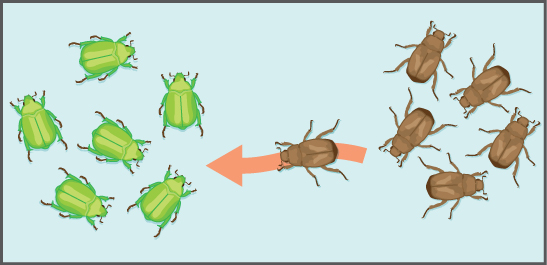 Figure four. Gene flow tin can occur when an private travels from one geographic location to another.
Another of import evolutionary force is gene flow: the flow of alleles in and out of a population due to the migration of individuals or gametes (Figure 4). While some populations are fairly stable, others feel more flux. Many plants, for example, transport their pollen far and wide, past wind or by bird, to pollinate other populations of the same species some distance away. Even a population that may initially appear to be stable, such equally a pride of lions, can experience its fair share of immigration and emigration equally developing males get out their mothers to seek out a new pride with genetically unrelated females. This variable menses of individuals in and out of the group not simply changes the gene structure of the population, but it tin can also introduce new genetic variation to populations in different geological locations and habitats.
Mutation
Mutations are changes to an organism's DNA and are an important driver of diversity in populations. Species evolve considering of the aggregating of mutations that occur over time. The appearance of new mutations is the nigh common style to introduce novel genotypic and phenotypic variance. Some mutations are unfavorable or harmful and are quickly eliminated from the population by natural selection. Others are beneficial and will spread through the population. Whether or non a mutation is beneficial or harmful is adamant by whether it helps an organism survive to sexual maturity and reproduce. Some mutations practice not exercise anything and can linger, unaffected by natural selection, in the genome. Some tin can have a dramatic upshot on a factor and the resulting phenotype.
Nonrandom Mating
If individuals nonrandomly mate with their peers, the result tin can be a irresolute population. There are many reasons nonrandom mating occurs. Ane reason is simple mate pick; for example, female peahens may prefer peacocks with bigger, brighter tails. Traits that atomic number 82 to more matings for an individual become selected for by natural selection. Ane common form of mate choice, chosen assortative mating, is an individual'south preference to mate with partners who are phenotypically like to themselves.
Another cause of nonrandom mating is physical location. This is especially true in big populations spread over large geographic distances where non all individuals volition have equal admission to i another. Some might be miles autonomously through forest or over rough terrain, while others might alive immediately nearby.
Environmental Variance
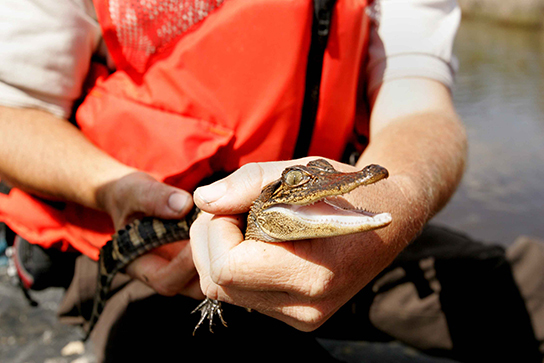 Figure 5. The sex of the American alligator (Alligator mississippiensis) is determined past the temperature at which the eggs are incubated. Eggs incubated at thirty°C produce females, and eggs incubated at 33°C produce males. (credit: Steve Hillebrand, USFWS)
Genes are not the only players involved in determining population variation. Phenotypes are besides influenced by other factors, such as the surround (Figure 5). A beachgoer is likely to have darker peel than a metropolis dweller, for example, due to regular exposure to the sun, an environmental factor. Some major characteristics, such as gender, are determined by the environs for some species. For example, some turtles and other reptiles take temperature-dependent sexual practice determination (TSD). TSD means that individuals develop into males if their eggs are incubated inside a certain temperature range, or females at a different temperature range.
Geographic separation between populations tin pb to differences in the phenotypic variation between those populations. Such geographical variation is seen between almost populations and tin be significant. I type of geographic variation, called a cline, can be seen as populations of a given species vary gradually beyond an ecological slope. Species of warm-blooded animals, for case, tend to have larger bodies in the libation climates closer to the earth'due south poles, allowing them to improve conserve estrus. This is considered a latitudinal cline. Alternatively, flowering plants tend to blossom at different times depending on where they are along the gradient of a mountain, known as an altitudinal cline.
If in that location is gene period between the populations, the individuals will likely show gradual differences in phenotype along the cline. Restricted cistron flow, on the other mitt, tin can lead to precipitous differences, fifty-fifty speciation.
Department Summary
Both genetic and ecology factors can crusade phenotypic variation in a population. Unlike alleles tin can confer dissimilar phenotypes, and different environments can also cause individuals to look or act differently. But those differences encoded in an private's genes, however, tin be passed to its offspring and, thus, exist a target of natural selection. Natural selection works by selecting for alleles that confer beneficial traits or behaviors, while selecting confronting those for deleterious qualities. Genetic drift stems from the run a risk occurrence that some individuals in the germ line have more than offspring than others. When individuals leave or join the population, allele frequencies tin change equally a result of gene flow. Mutations to an individual's Dna may introduce new variation into a population. Allele frequencies tin also be altered when individuals practise not randomly mate with others in the group.
https://www.openassessments.org/assessments/512
Additional Self Cheque Questions
- Do you retrieve genetic drift would happen more quickly on an island or on the mainland?
- Describe a situation in which a population would undergo the bottleneck effect and explain what impact that would have on the population's gene pool.
- Depict natural option and requite an example of natural selection at work in a population.
- Explain what a cline is and provide examples.
Answers
- Genetic drift is likely to occur more rapidly on an island where smaller populations are expected to occur.
- A hurricane kills a big percentage of a population of sand-abode crustaceans—only a few individuals survive. The alleles carried by those surviving individuals would represent the entire population'due south gene pool. If those surviving individuals are non representative of the original population, the post-hurricane gene puddle volition differ from the original genetic pool.
- The theory of natural selection stems from the observation that some individuals in a population survive longer and have more offspring than others: thus, more of their genes are passed to the next generation. For example, a big, powerful male person gorilla is much more likely than a smaller, weaker one to get the population'south silverback: the pack'due south leader who mates far more than than the other males of the group. Therefore, the pack leader will father more offspring who share half of his genes and are likely to grow bigger and stronger like their father. Over time, the genes for bigger size will increase in frequency in the population, and the average body size, every bit a result, grow larger on average.
- A cline is a type of geographic variation that is seen in populations of a given species that vary gradually beyond an ecological slope. For example, warm-blooded animals tend to accept larger bodies in the cooler climates closer to the earth'southward poles, allowing them to better conserve heat. This is considered a latitudinal cline. Flowering plants tend to bloom at dissimilar times depending on where they are along the slope of a mount. This is known as an altitudinal cline.
Glossary
assortative mating: when individuals tend to mate with those who are phenotypically similar to themselves
clogging event: magnification of genetic drift as a issue of natural events or catastrophes
cline: gradual geographic variation beyond an ecological gradient
gene flow: menstruation of alleles in and out of a population due to the migration of individuals or gametes
genetic drift: event of chance on a population's gene pool
genetic variance: diversity of alleles and genotypes in a population
geographical variation: differences in the phenotypic variation between populations that are separated geographically
heritability: fraction of population variation that can be attributed to its genetic variance
inbreeding: mating of closely related individuals
inbreeding depression: increase in abnormalities and disease in inbreeding populations
nonrandom mating: changes in a population's gene pool due to mate pick or other forces that cause individuals to mate with certain phenotypes more others
population variation: distribution of phenotypes in a population
selective pressure: environmental factor that causes one phenotype to be better than another
Source: https://courses.lumenlearning.com/biology1/chapter/283/
Posted by: maconexpearre.blogspot.com
0 Response to "How Do We Characterize A Population's Genetic Makeup"
Post a Comment